

Kurohane 450X Field Test: 60+ Mackerel at Chesil Beach

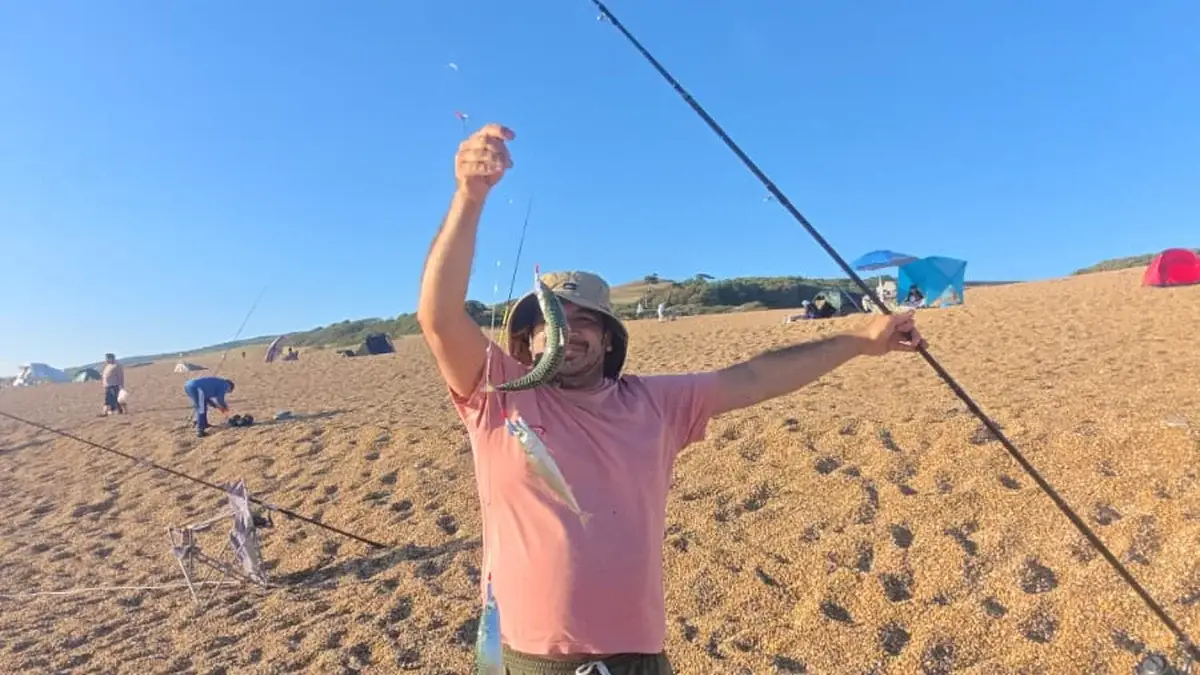
60+ Mackerel. One Intense Hour.
An intensive evening at Chesil Beach, Abbotsbury, gave us the opportunity to put the TAA Kurohane 450X surfcasting prototype through continuous real-world casting, retrieval and multiple-fish loading.
60+
Mackerel landed during the peak fishing period
~1 Hour
Concentrated, high-intensity fishing
450X
Progressive-fast surfcasting development prototype
There is a point in the development of a fishing rod when specifications on paper stop being enough.
Carbon modulus, casting ratings, guide layouts and action profiles all matter, but ultimately a surfcasting rod has to prove itself where anglers actually use it: on the beach, into the wind, repeatedly casting, retrieving fish and dealing with the unpredictable conditions of the British coastline.
On Saturday 5 September 2026, we took the TAA Kurohane 450X back to one of our benchmark testing grounds: Chesil Beach at Abbotsbury, Dorset.
The target on this occasion was mackerel. The objective, however, was much bigger.
We wanted to see how the Kurohane 450X behaved during an intense period of repetitive casting and fish retrieval. We wanted to assess how quickly the blank loaded, how cleanly it recovered and how effectively it transmitted movement from the terminal tackle.
More than 60 mackerel were landed in approximately one hour. But the most important part of the session was what those fish allowed us to learn about the rod.
This field report examines the prototype's casting action, blank recovery, sensitivity, balance, guide performance and control under changing loads.
Why Chesil Beach Is an Important Testing Ground
Chesil Beach has become an important proving ground in the development of TAA sea-fishing equipment.
Abbotsbury sits on the famous shingle bank of Chesil Beach and is well known among shore anglers, including for summer and early-autumn mackerel fishing.
Its steeply shelving shoreline provides access to deeper water relatively close to shore. Its exposure also means that wind, waves and changing sea conditions can quickly become part of the fishing.
That is exactly why we value it as a development venue.

A rod that feels impressive for half a dozen casts in controlled conditions has not necessarily demonstrated very much.
Put that same rod onto Chesil, ask it to cast repeatedly, work terminal tackle through the water, register multiple fish and absorb changing loads, and shortcomings can become apparent very quickly.
Real water. Real casts. Real fish. Repeat.
That is the philosophy behind the development of the Kurohane 450X.
Weather and Sea Conditions at Abbotsbury
Testing took place during the early evening, broadly between 5:30pm and 7:30pm. It was a relatively comfortable September evening, but not completely still.
Nearby historical observations around Weymouth indicated temperatures of approximately 18–19°C during the relevant evening hours, with no rainfall recorded.
Winds were predominantly south-westerly to west-south-westerly, running at roughly 17–19 km/h, with gusts around 20–22 km/h.
Offshore observations around Chesil indicated significant wave heights of approximately 2 ft, with sea temperatures around 19.3–19.5°C.
These figures provide useful background, although actual conditions on the beach can differ from nearby monitoring stations.
There was enough breeze and sea movement to evaluate blank recovery, tip movement and casting stability, without weather conditions overwhelming the test.
Engineering / Development Platform
TAA Kurohane 450X Prototype Specifications
The development programme centres on a three-piece, high-modulus carbon surfcasting platform with a progressive-fast action.
- Model
- TAA Kurohane 450X
- Rod Type
- Three-Piece Surfcasting Rod
- Length
- 4.50 m / Approximately 14 ft 9 in
- Action
- Progressive-Fast
- Carbon Concept
- High-Modulus 40T/46T Toray Carbon
- Resin Technology
- Japanese Nano-Resin Concept
- Target Total Casting Load
- 150–250g Including Lead and Bait
- Guide System
- Fuji K-Series Stainless Steel / SiC
- Reel Seat
- Fixed Fuji DPS
- Grip Concept
- Dual-Density EVA
- Joints
- Precision Spigot-Style
- September Test Status
- Development Prototype
Development notice:
These specifications describe the rod
during its development programme.
Refer to the official product page
for the latest published configuration
and launch details.
None of these individual materials or component names matters if the complete rod does not work as a system.
A high-modulus carbon blank needs to load naturally, the guide configuration must work with the blank's action, and the grip and reel seat must support practical handling during repeated use.
Explore the Kurohane: For the latest technical specifications, product information and planned launch details, visit the Kurohane 450X surf fishing rod product page at TAA Fishing.
How the Kurohane 450X Loads During Casting
One of the central development characteristics of the Kurohane 450X is its progressive-fast action.
We did not want to develop a rod that simply feels extremely stiff in the hand. A beach rod still needs to load.
Energy must travel efficiently into the blank during the casting stroke before being released into the lead and terminal tackle.
During the Abbotsbury test, the prototype demonstrated encouraging progressive loading characteristics.
As casting pressure increased, the blank loaded progressively rather than feeling abrupt or requiring excessive force.
The lower sections provided power reserve, while the upper sections allowed the casting stroke to develop naturally.
Why Repeatable Casting Matters
Maximum distance matters in surfcasting, particularly on large open beaches such as Chesil.
But one impressive cast does not necessarily demonstrate how a rod will behave during prolonged fishing.
Repeatable casting performance matters more than one impressive throw.
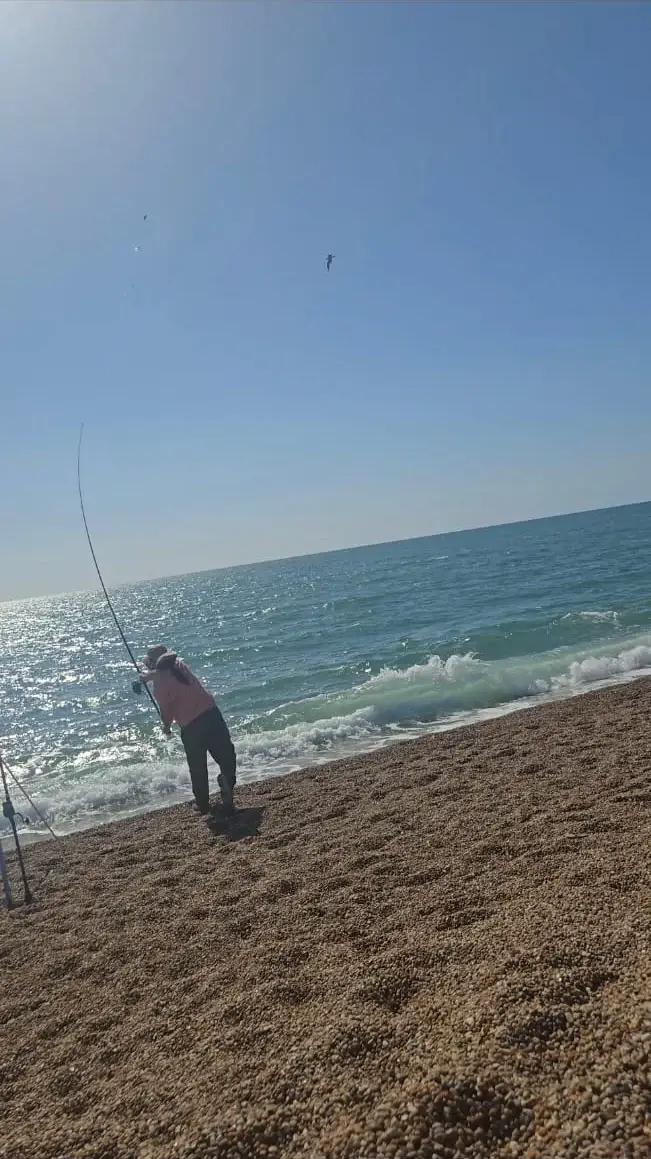
During an active mackerel session there is very little downtime: cast, retrieve, unhook, reset and cast again.
Landing more than 60 fish during approximately one hour provided a useful real-world endurance-style test for the Kurohane.
The rod was being used repeatedly, allowing us to assess how much effort each casting and retrieval cycle required.
Throughout the concentrated period, the 450X continued to feel composed and manageable.
Blank Recovery After the Cast
Blank recovery has been another important focus during development.
Once a rod releases a cast, the tip should settle promptly rather than continuing to oscillate unnecessarily.
Excessive recovery movement can influence casting efficiency and line behaviour through the guide train.
At Abbotsbury, the prototype showed encouraging recovery characteristics. Following release, the tip appeared to settle quickly without prolonged, loose-feeling movement.
The overall casting action felt crisp rather than violent.
More Than 60 Mackerel in Approximately One Hour
Once the fish were located, the character of the session changed very quickly.
Hits started coming regularly. Then repeatedly.
At times, more than one mackerel was attached to the tackle simultaneously.
Several fish pulling in different directions introduce changing loads through the rig.
The blank needs to absorb these movements while still allowing the angler to maintain control.
This is where the progressive character of the Kurohane became particularly noticeable.

Why the Catch Result Mattered
From a fishing perspective, it was an exceptional spell of activity.
From a product-development perspective, it was particularly valuable because of the repeated demands placed on the rod.
Load. Release. Recovery. Retrieve. Fish load. Lift. Reset. Repeat.
Every cast and retrieve represented another working cycle through the blank.
Dozens of repetitions helped us assess consistency rather than relying on first impressions.
Sensitivity, Bite Detection and Fish Control
Mackerel fishing presents a different test from casting a conventional beach ledger rig and waiting for a bite.
The rod remains in the angler's hands, with the tackle actively worked through the water column.
Feedback Through the Blank
Although feeding mackerel are hardly known for delicate takes, repeated hookups provided useful opportunities to assess sensitivity.
Contact through the terminal tackle could be felt clearly, and changes in load were immediately noticeable when fish were attached.
That feedback remained perceptible despite the Kurohane being a long, powerful surfcasting platform.
Power when the blank is asked for it. Feedback when the angler needs it.
Control Under Multiple-Fish Loads
When several mackerel loaded the tackle simultaneously, the blank continued to bend progressively.
The upper sections responded first, while heavier loads brought more of the blank into action.
This provided a reassuring feeling of available reserve and control under the conditions encountered.
Balance and Comfort During Repeated Casting
Over dozens of repetitions, relatively small shortcomings in weight distribution or ergonomics can become tiring.
At Abbotsbury, the Kurohane 450X remained manageable throughout the high-intensity fishing period.
Its length provided useful leverage and line control without making the tackle feel disconnected from the angler.
That combination of length, power and practical feedback was an encouraging result for the development team.
Fuji Guide Performance and Line Flow
Guide configuration is an important part of surfcasting rod development.
Poor guide spacing or unnecessary line contact can undermine an otherwise promising blank.
Throughout the session, we watched for abnormal line slap, instability and signs that spacing or alignment might need refinement.
The Fuji K-Series-based arrangement continued to demonstrate encouraging line management.
Stability in the Coastal Breeze
The prevailing breeze added another useful element to the test.
Casting in moving air exposes issues that may be less obvious in still conditions.
The Kurohane remained composed through the casting stroke. Efficient loading and clean recovery helped maintain a comfortable and repeatable casting rhythm.
What We Learned From the Abbotsbury Test
The biggest takeaway was not simply that the Kurohane 450X could catch mackerel.
The meaningful result was how the rod behaved while doing it repeatedly.
Progressive Loading
The blank loaded smoothly without feeling excessively abrupt or stiff.
Controlled Recovery
The tip settled promptly after release, producing a crisp casting sensation.
Casting Consistency
The prototype remained composed throughout repeated casting and retrieval cycles.
Fish Detection
Strikes and changing tackle loads remained clearly perceptible through the blank.
Multiple-Fish Control
Heavier loads progressively engaged more of the blank without abrupt lock-up.
Practical Balance
The rod remained manageable during the concentrated period of active fishing.
What This Test Does Not Prove
This was a demanding real-world fishing session rather than a controlled laboratory fatigue test or quantified maximum-distance trial.
It does not independently establish maximum casting distance, long-term durability or performance across every possible sea condition.
It does provide valuable practical observations to compare with the wider development programme.
Why Testing Continued Beyond Abbotsbury
It would have been easy to take a session involving more than 60 mackerel and declare the development complete.
That is not how we approached the Kurohane project.
The Abbotsbury session provided another important set of observations to compare against previous and future testing.
The wider programme considered different casting loads, terminal tackle, wind directions, sea states, target species, guide arrangements and practical handling requirements.
Real-world development has remained central to the philosophy behind the Kurohane 450X.
The official product page contains the latest specifications and planned launch information.
Kurohane 450X Frequently Asked Questions
What is the TAA Kurohane 450X?
The TAA Kurohane 450X is a 4.5-metre surfcasting rod developed through real-world UK shore-fishing tests, with an emphasis on progressive casting power, recovery, sensitivity and balance.
How long is the Kurohane 450X?
The rod measures approximately 4.5 metres, or 14 ft 9 in, and uses a three-piece configuration.
What is its casting weight?
The published casting range is 150–250g total load, including lead and bait.
What action does the rod have?
The Kurohane 450X uses a progressive-fast action designed for controlled loading, recovery and responsiveness.
Is it suitable for mackerel fishing?
The prototype was successfully used during active mackerel fishing at Chesil Beach. However, it was developed as a broader surfcasting platform.
How many mackerel were caught?
More than 60 mackerel were landed during approximately one hour of concentrated fishing within a two-hour testing session.
Where was the rod tested?
This field test took place at Chesil Beach, Abbotsbury, Dorset, on Saturday 5 September 2026.
Is the Kurohane 450X available to buy?
As of October 2026, the rod is not available to purchase or pre-order. TAA Fishing is planning a UK launch in February 2027, subject to confirmation.
Built on the Beach, Not Just on Paper
The evening at Abbotsbury encapsulated exactly why the Kurohane 450X project exists.
Standing on the shingle at Chesil Beach, repeatedly casting as another shoal of mackerel passed through, there was no laboratory between the rod and its environment.
Every cast told us something.
Every retrieve told us something.
Every fish placed another type of load through the blank.
After more than 60 mackerel in approximately one hour, the rod had experienced considerably more than a casual evening beside the sea.
It had worked. Hard.
That is the kind of development testing we believe fishing equipment deserves.
Abbotsbury on 5 September 2026 was an important part of the Kurohane 450X development story.
More than 60 mackerel. One intense hour. Repeated moments of loading, recovery, sensitivity and control.
Kurohane 450X.Developed on real UK waters.
Refined cast by cast.
TAA Fishing | The Amateur Angler
