
AEGIS 420X Surf Rod Field Test at Chesil Beach


AEGIS 420X Surf Rod: Real-World Testing at Chesil Beach
What happens when a 4.20 m surfcasting prototype leaves the specification sheet and meets a demanding Dorset shingle beach?
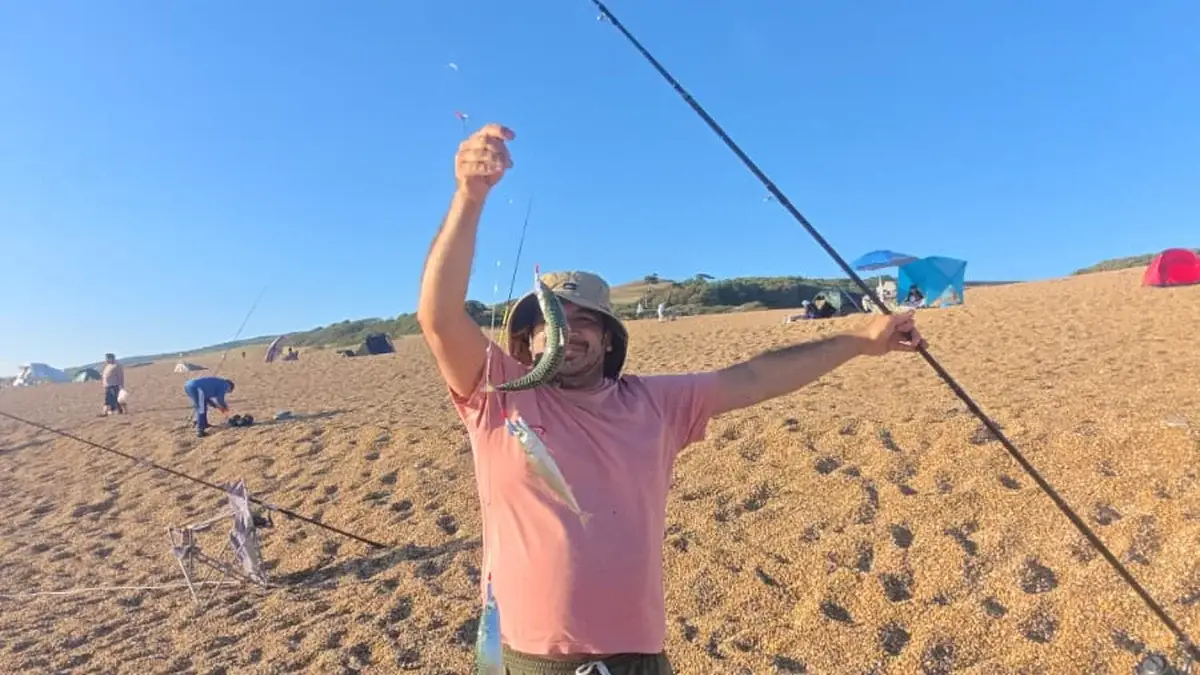
On 4 January 2026, TAA Fishing returned to Chesil Beach to examine the AEGIS 420X under practical UK shore-casting conditions. Our focus was on how the rod loaded, recovered and handled repeated casting, rather than claiming an unverified record distance.
Field test: 4 January 2026
Location: Chesil Beach, Dorset
Programme: TAA AEGIS development
4.20 m
Three-piece surfcasting rod
100–250 g
Current published casting range
≈485 g
Current prototype weight
40T + 46T
Toray mixed-modulus carbon blank
Carbon grades, casting weights and component names help describe a fishing rod. They cannot, on their own, show how the complete setup responds when an angler casts it repeatedly from an exposed beach.
That distinction is central to the AEGIS 420X development programme. Our objective is to develop a surf rod that feels controlled and predictable during real UK fishing sessions, not merely impressive on a specification sheet.
Why Test a Surfcasting Rod at Chesil Beach?
Chesil Beach in Dorset offers steep shingle, open-water exposure and changing coastal conditions. Those characteristics make it a useful environment for investigating how shore-fishing tackle behaves under realistic working loads.
On a beach like Chesil, a prototype must be considered as a complete system. The blank, guide train, reel position, grips and terminal tackle all contribute to the angler's experience.
Repeated casting can reveal handling characteristics that are easy to overlook during a few isolated casts. For the January AEGIS session, the priority was to gather practical development feedback rather than declare the rod suitable for every fishing venue.
The important question was whether the AEGIS behaved
consistently on the beach, not simply whether its
specification looked convincing on paper.
What Did the 4 January 2026 Field Test Assess?
The session continued the development assessment around five interconnected characteristics of surfcasting rod performance.
- Progressive loading: Whether the blank compressed smoothly as casting effort increased.
- Post-release recovery: How the upper section settled after the cast.
- Guide and line behaviour: How the guide layout worked with practical fixed-spool surfcasting setups.
- Balance and ergonomics: How the complete rod felt during repeated casting.
- Consistency: Whether the casting action remained predictable rather than depending on one standout attempt.
Testing transparency: This field report does not publish verified casting distances, controlled wind-speed measurements, total casting repetitions or independently certified load comparisons.
AEGIS 420X Surfcasting Rod Specifications
The following technical specifications describe the current AEGIS 420X development platform. Individual components and ratings may be refined before the final production configuration is confirmed.
| Specification | Current AEGIS 420X Prototype |
|---|---|
| Model | TAA AEGIS 420X |
| Status | Testing phase |
| Rod type | Three-piece surfcasting rod |
| Length | 4.20 m / 420 cm / approx. 13 ft 9 in |
| Carbon blank | Toray 40T + 46T hybrid carbon |
| Casting range | 100–250 g |
| Rod weight | Approximately 485 g |
| Guide system | Fuji KW Alconite K-Series |
| Reel seat | Fuji DPS-24 |
| Grip | Japanese shrink grip |
| Butt | Ergonomic EVA flared butt |
| Reinforcement | 3K carbon at selected butt and ferrule areas |
| Tip finish | High-visibility white |
| Intended use | UK shore and surf fishing |
Development specification: These figures reflect the current published test configuration. For updates, visit the AEGIS 420X product page.
How Does the AEGIS 420X Load During Casting?
A principal development objective for the AEGIS 420X is progressive loading: enabling the blank to compress smoothly during the casting stroke rather than feeling unnecessarily abrupt or excessively stiff.
At Chesil Beach, the team continued assessing mid-section compression and how predictable the rod felt as casting effort increased.
The design objective is controlled power delivery that an angler can reproduce throughout a normal shore-fishing session.
Why Repeatable Casting Matters
One long cast is a limited measure of a useful beachcasting rod. Shore anglers regularly cast again and again while adjusting bait presentations, rigs, lead weights and technique.
A practical surf rod therefore needs consistent handling, not simply the potential for a single impressive distance.
The January field session was part of this continuing evaluation. No certified maximum casting distance was established during the test.
AEGIS 420X Tip Recovery and Casting Control
After the lead leaves the rod, the blank returns from compression. The way the tip settles during this recovery phase is an important part of the overall casting action.
Excessive upper-section oscillation can make a casting action feel unsettled and influence how line moves through the guide train.
The current AEGIS 420X carbon construction combines Toray 40T and 46T materials, with the development aim of balancing progressive loading and responsive upper-section recovery.
At Chesil Beach, recovery characteristics were assessed alongside the loading profile because both behaviours need to work together.
These observations represent development feedback, not independently measured recovery speeds or certified improvements in casting accuracy.
Fuji KW Alconite Guides and Line Flow
The current AEGIS 420X test configuration uses Fuji KW K-Series guides with Alconite rings.
Guide selection is one part of the equation. Spacing, alignment and the relationship between the guide train and blank action are equally relevant to practical line management.
Development testing includes observations using modern fixed-spool surfcasting setups with monofilament and braided main lines.
The team continues to consider guide positioning alongside the rod's loading and recovery characteristics before confirming the final production layout.
Balance and Handling During Repeated Beach Casting
The current AEGIS 420X prototype weighs approximately 485 g. However, static rod weight does not reveal everything about handling during a long session.
Reel position, grip shape, butt design and weight distribution all influence how manageable a surfcasting setup feels during repeated casting.
The Chesil Beach testing programme evaluates these characteristics in practical use rather than relying only on the rod's published weight.
Components Selected for UK Shore Fishing
Fuji DPS-24 Reel Seat
Selected to provide secure reel retention in the current shore-fishing configuration.
Japanese Shrink Grip
Intended to provide positive hand contact during wet coastal fishing sessions.
Ergonomic EVA Flared Butt
Designed for supportive handling during the casting stroke.
High-Visibility White Tip
Intended to improve the visibility of bite indications in changing light.
3K Carbon Reinforcement
Applied around selected butt and ferrule areas on the development prototype.
UK-Led Development
Subtle Union Jack detailing reflects the rod's UK development identity.
What Did TAA Learn From the Chesil Beach Test?
The value of the January session came from observing how the complete prototype behaved under real shore-casting conditions.
Four development areas remained central to the assessment.
Progressive Loading
Continued evaluation of smooth blank compression as casting effort increases.
Recovery Behaviour
Close attention to how the tip and upper blank settle after release.
Guide Arrangement
Observations of line flow, guide spacing and alignment with fixed-spool setups.
Practical Balance
Feedback on weight distribution and the handling of the complete rod during repeated casting.
What This Session Does Not Prove
The Chesil Beach session was a practical field test, not an independently controlled laboratory fatigue trial or certified casting-distance competition.
It cannot establish absolute maximum casting distance, independently verified durability or performance under every possible fishing load and weather condition.
It does provide additional practical observations to inform the wider AEGIS development programme.
Is the AEGIS 420X Ready for Production?
The AEGIS 420X remains in its testing phase. Its final production specification, price and availability have not yet been confirmed.
The Chesil Beach report documents one stage in the development programme. It is not a formal production-release announcement.
Further evaluation and feedback may continue to inform the final configuration.
Develop through real use. Refine through evidence.
Confirm the specification only when the testing
supports it.
AEGIS 420X Frequently Asked Questions
What is the AEGIS 420X?
The AEGIS 420X is a 4.20 m three-piece surfcasting rod being developed by TAA Fishing for UK shore and beach fishing.
How long is the AEGIS 420X surf rod?
Its current length is 4.20 metres, or 420 cm, approximately 13 feet 9 inches.
What is the AEGIS 420X casting weight?
The current published casting range is 100–250 g. This remains a development specification and may be refined before production.
What carbon does the AEGIS 420X use?
The current test blank uses mixed-modulus Toray 40T and 46T carbon.
Which guides does the AEGIS 420X use?
The current configuration uses Fuji KW Alconite K-Series guides.
Where was the AEGIS 420X tested?
This field report documents a development testing session at Chesil Beach, Dorset, on 4 January 2026.
Is the AEGIS 420X the same as the Kurohane 450X?
No. They are separate TAA surfcasting models. The AEGIS is a 4.20 m development platform with Fuji KW Alconite guides, while the Kurohane 450X is a 4.50 m model with Fuji K-Series SiC guides.
Can I buy or pre-order the AEGIS 420X?
Not currently. The rod remains in testing, and its final price, release date and production specification have not been confirmed.
Explore the AEGIS 420X Product Specification
View the latest published development specifications, components and availability status on the dedicated TAA Fishing product page.
View the AEGIS 420X Surf RodExplore more TAA Fishing content: Browse our sea fishing rods or read the Kurohane 450X Chesil Beach field report for another example of TAA's real-world development testing.
Prototype Development Notice: The AEGIS 420X described in this article is a development-stage test configuration. Published components, weight and casting ratings may change before production. Field observations are practical development feedback, not independently certified technical performance measurements.